Measuring Performance Improvements with the Snowflake Performance Index

At Snowflake Summit, we announced the public launch of the Snowflake Performance Index (“SPI”), an aggregate index for measuring real-world improvements in Snowflake performance experienced by customers over time.
At Snowflake, our product philosophy revolves around continuously enhancing the performance of our product, particularly the core database engine. We prioritize delivering regular performance improvements to our customers through our weekly release process, without any additional effort or cost on their part. When we make enhancements to the functionality our customers use, these changes seamlessly and transparently provide benefits to those workloads. As a result, customers experience immediate performance boosts without having to lift a finger. Moreover, our consumption-based pricing model often leads to direct cost savings for customers as their workloads become faster. This synergy between our relentless focus on performance improvement and the subsequent reduction in costs enhances customer satisfaction, showcasing the alignment of our incentives with theirs. Ultimately, the combination of optimized workloads, timely transformations, and accelerated decision-making translates to increased business value for both our customers and Snowflake.
To help us measure the impact of these regular improvements, we turn to the SPI, which allows us to measure the impact of our continued commitment to improving price for performance for customers. The SPI is calculated on stable and recurring workloads (read more about that here) that allows us to compare improvements on specific customer workloads over time. In the past, vendors have turned to synthetic benchmarks as a proxy to showcase price for performance. But this approach doesn’t account for the characteristics of real-world customer workloads such as demand elasticity, complex security access policies, and schema design. In contrast to synthetic benchmarks, the SPI is calculated based on real-world customer workloads, and measures customer-experienced price for performance.
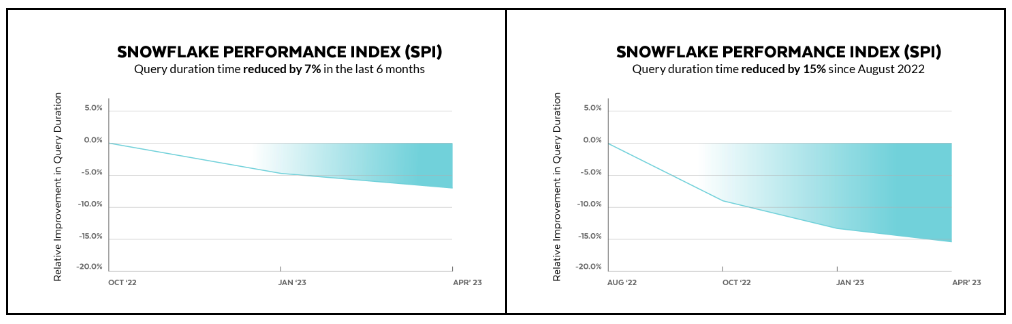
From the above figures, you can see that Query Duration for customers’ stable workloads has improved by 7% between October 31, 2022 and April 30, 2023. Since we started tracking the SPI in August 2022, Query Duration for customers’ stable workloads has improved by 15%.*
An example of the kind of price for performance improvement that is reflected in the SPI is an improvement to Snowflake warehouses to handle more concurrent jobs and scale better for workloads that execute frequent, highly concurrent DML operations. Another example is an improvement in query duration by automatically excluding redundant join conditions in complex queries. These improvements and others are delivered with nearly every weekly release. Keep an eye on the key performance improvements page in Snowflake Documentation to see all the features that are helping you run more efficiently.
The SPI highlights “Snowflake’s commitment to continuously improve economics for our customers”, and provides more transparency on the quantitative impact of platform performance improvements on customers’ production workloads over time. The SPI also allows us to continuously measure and improve the performance impact of new features, enhancements, and compute options for our customers.
Visit the new SPI website to learn more.
*Based on internal Snowflake data from October 31, 2022 to April 30, 2023 and August 25, 2022 to April 30, 2023, respectively. To calculate SPI, we identify a group of customer workloads that are stable and comparable in both amount of queries and data processed over the period presented. Reduction in query duration resulted from a combination of factors, including hardware and software improvements and customer optimizations.
Authors